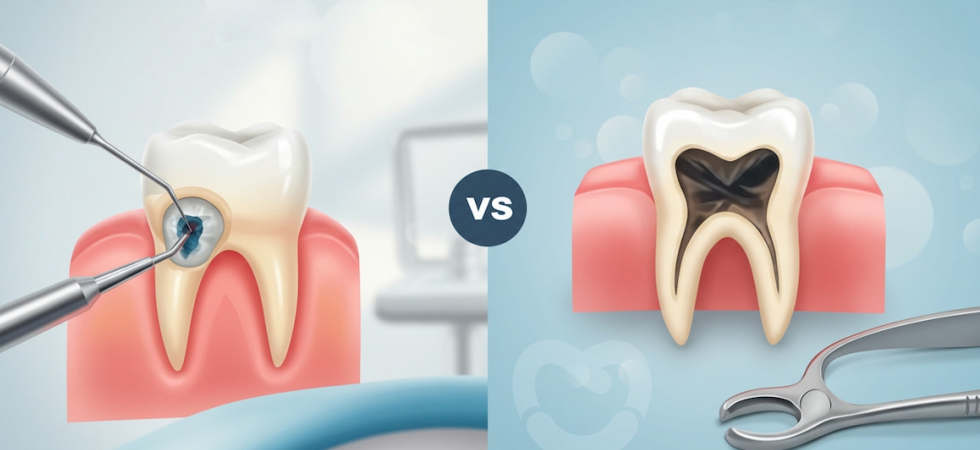
A dental emergency in India usually starts with one dramatic Google search: “dental clinic close to me” or “dentistry clinic near me”, followed by you holding your cheek and questioning all your life choices. Let’s untangle the big question at the heart of that panic: root canal vs tooth extraction in India, in terms of cost, pain, recovery, and long‑term impact.
First Things First, What Are We Actually Dealing With?
Most people end up in a clinic thanks to tooth decay and cavity issues that were politely ignored until they developed into full-blown agony. Sometimes the villain is a decayed molar, sometimes it’s the infamous tooth of wisdom causing trouble at the back.
Your dentist will usually suggest either Root canal treatment (save the tooth) or Tooth extraction (remove the tooth entirely).
Both are valid. The smarter choice depends on the condition of the tooth, your budget, your pain tolerance, and how much you like chewing on both sides of your mouth. Visit clinics like OneDentall to know about which service is the optimal choice for your treatment.
Pricing in India: Root Canal vs Extraction
Let’s talk about money before molars. You see plenty of searches like root treatment cost, teeth filling cost, root canal cost India, and tooth extraction cost India for a reason: nobody wants a bill that hurts more than their teeth.
Root Canal Cost In India
Across India, a root canal cost in India typically ranges from about ₹3,000 to ₹12,000 per tooth, depending on the tooth (front vs molar), city, and clinic type. Metro clinics, microscope use, or premium setups can push it up to ₹8,000–₹15,000+.
If the tooth also needs a crown for teeth, that’s another ₹3,000–₹15,000 or more, depending on material (metal, PFM, zirconia). That’s why people search for a dentist and then quietly recheck their bank balance.
Tooth Extraction Cost In India
A simple teeth removal in India can be surprisingly affordable, often ₹500–₹2,000 in basic setups for non‑surgical cases. But when it becomes teeth removal, wisdom or surgical extraction, the tooth extraction cost in India can jump to ₹2,500–₹10,000+, especially for impacted wisdom teeth.
On paper, extraction usually looks cheaper than a full root canal + crown for teeth. But remember: once the tooth is gone, replacing it with a bridge or implant is a separate (and often bigger) expense later.
Pain: How Bad Is Root Canal Pain vs Tooth Extraction Pain?
People type root canal pain, tooth extraction pain, and then scare themselves reading horror stories. Reality check: modern dentistry is far kinder than the internet.
Root Canal Pain
With proper anaesthesia, root canal pain during the procedure is usually similar to getting fillers for teeth or a regular teeth filling, pressure, mild discomfort, but not “scream in the chair” levels. The real relief comes after, because the infected nerve is cleaned out, so that the deep, throbbing pain from tooth decay and cavity finally calms down.
You might feel soreness when biting for a few days, but it’s usually manageable with regular painkillers, and your root canal recovery time is often just a couple of days of caution.
Tooth Extraction Pain
With extractions, the actual procedure is also painless under local anaesthesia. The drama begins after. Tooth extraction pain peaks once the numbness fades and your body realises something (like a very stubborn tooth of wisdom) just got evicted.
For simple extractions, pain is usually moderate and settles over 2–3 days. For surgical or wisdom teeth removal, especially impacted ones, tooth extraction recovery can be a week of careful chewing, salt-water rinses, and you questioning every crunchy snack you ever loved.
Recovery Time: Root Canal Recovery vs Tooth Extraction Recovery
Here’s where root canal or extraction becomes more than just a cost question.
Root Canal Recovery Time
Most people can return to normal life immediately after a root canal, and many even go back to work the same day. There may be mild tenderness for a few days, but once the crown or fillers for teeth are placed, the tooth functions almost normally. Your chewing stays balanced, and neighbouring teeth stay in place.
Tooth Extraction Recovery
After extraction, especially teeth removal of wisdom teeth, your body needs time to close the socket and form new tissue. Depending on the case, Basic extractions: 2–3 days of discomfort, 7–10 days for main healing. Surgical or impacted wisdom tooth extraction: swelling, stiffness, and tooth extraction recovery of about 1–2 weeks.
You have to be extra careful about not disturbing the blood clot to avoid dry socket, something you definitely don’t want if you already hate tooth extraction pain.
Long-term impact: Function, Looks and Future Problems
This is where the “cheap now vs expensive later” question really matters.
Keeping the tooth: root canal + restoration
A successful root canal, followed by proper teeth filling, cost investment and a good crown for teeth, can let that tooth function for many years, sometimes decades.
Advantages: You keep your natural tooth structure. Bite forces stay balanced. Nearby teeth don’t drift or tilt into a space. Jawbone in that area stays stimulated and healthy, reducing long‑term bone loss.
For many dentists, and many explorers of “dental clinic close to me” or “dentistry clinic near me”, root canal is the first choice when the tooth can still be saved.
Losing the tooth: extraction without replacement.
If you choose extraction and don’t replace the tooth, a few things can happen over time: Opposing teeth may “over‑erupt” into the gap. Neighbouring teeth can tilt, creating food traps and more tooth decay and cavities. Chewing efficiency drops, especially if multiple teeth are missing.
Future fixes, implants, bridges, or dentures add to your lifetime dental bill, often making the “cheaper today” option more expensive overall.
When does extraction actually make more sense?
Despite all the love for saving teeth, there are clear cases where teeth removal is the sensible choice.
The tooth is fractured vertically or split in half. There’s very little tooth left above the gum for a crown for the teeth to hold onto. Chronic infection or cysts around the root have a poor prognosis. Severely impacted tooth of wisdom tooth causing repeated infections and biting issues.
In these cases, even the best dental braces on teeth, dental clips for teeth, or a top dentistry clinic near me won’t recommend heroic saving attempts if the long‑term outlook is weak. Extraction plus a planned replacement can be more predictable.
Cost vs value: the realistic India picture
If you only look at the initial root treatment cost vs the tooth extraction cost in India, extraction often wins on price. But once you add: Future crown for teeth, Possible implants or bridges, Risk of more tooth decay and cavities nearby, A well-done root canal costing India can actually be a very reasonable long-term value.
For context: Root canal + crown in India can still be significantly cheaper than the same treatment abroad, which is why many dental tourists search for root canal cost in India specifically. Extracting a problematic tooth of wisdom tooth may be the fastest, sanest solution if it’s impacted and non-functional anyway.
How to decide: a simple human checklist
When you next land at a dental clinic or a reputable dentistry clinic like the OneDentall, here’s how to think about root canal or extraction like a pro (but still a scared patient)
1. Ask about prognosis
If your dentist says, “This tooth has a good long‑term chance with a root canal and crown,” saving it is usually worth it.
If the prognosis is poor, extraction may save you repeated costs and root canal pain episodes.
2. Check the full cost picture
Don’t just ask the root treatment cost; also ask about teeth filling cost, crown fees, and follow‑ups.
For extraction, ask about future replacement options and ballpark pricing.
3. Think about your bite, not just one tooth
If the tooth is important for chewing (molars, especially), lean towards saving it if realistic. For a problematic, non-functional wisdom tooth of wisdom tooth removal was often the cleaner choice.
4. Be honest about your anxiety and schedule
If the idea of multiple visits terrifies you and you want a one‑and‑done solution, extraction might feel mentally easier, though your dentist can often do single‑sitting root canals, too.
Your teeth are real estate, treat them like it!
In the end, root canal vs tooth extraction in India is not about which is “good” or “bad,” but which is right for that specific tooth, in that specific mouth, at that specific time. Choose a root canal when the tooth is structurally sound, important for chewing, and you’re willing to invest in a crown for the tooth and proper care.
Choose tooth extraction when the tooth is beyond repair, the prognosis is poor, or it’s a troublesome tooth of wisdom with no real functional role. Whichever route you go, the smartest step is the first one: stop Googling dental clinics close to me in pain and actually walk into one like the OneDentall.That, and maybe not waiting until your tooth decay and cavity start starring in their own horror movie.
Your future self, with better chewing, fewer emergencies, and who can enjoy their favourite ice cream without any pain, will definitely thank you.
FAQs
1. If I have a decaying tooth, should I opt for a Root Canal or a Tooth Extraction?
It is always best to visit a reputable clinic like OneDental to get advice from the best dentist before jumping to your own conclusions or decisions.
2. What services does OneDental provide for dental needs?
OneDental provides comprehensive treatments like dental braces, root canals, crowns, fillings, tooth extractions, and wisdom tooth removal, all under one roof.
3. What is the cost for root canal treatment and tooth extraction at OneDental?
OneDental offers competitive pricing for root canal and tooth extraction procedures, with transparent cost estimates and expert care to ensure comfort and recovery.
4. Does OneDental handle dental braces and crowns for teeth?
Yes, OneDental specialises in dental braces and crowns, helping patients achieve straighter, healthier smiles with modern techniques and personalised care.
5. How does OneDental help with tooth decay, cavities, and pain management?
OneDental provides dental fillings, cavity prevention tips, and pain management for root canal and extraction procedures, ensuring a smooth and comfortable recovery experience.